


Stay up to date with Ohara Corp’s announcements and upcoming events.
| Date | Ref | Description |
|---|---|---|
| 30 Sep, 2026 | Nancy Grace Roman Space Telescope | Ohara optical glass in Coronagraph Instrument and Wide Field Instrument of NASA’s Nancy Grace Roman Space Telescope. Read More |
| 01 Aug, 2026 | NASA SBIR | Ohara’s CCZ supports NASA SBIR lightweight mirror development program. Read More |
| 29 Feb. 2024 | National Geographic E6 Glass | Ohara’s E6 Glass is featured in National Geographic’s The Glass Age. Read More |
| 20 Nov. 2023 | LLNL – NIF | Ohara optical glass and Fused Silica in the NIF! Read More |
| 06 Oct. 2023 | U of A – GMT7 | Ohara’s E6 glass is melted for the Giant Magellan Telescope’s last Primary Mirror, GMT7! Read More |
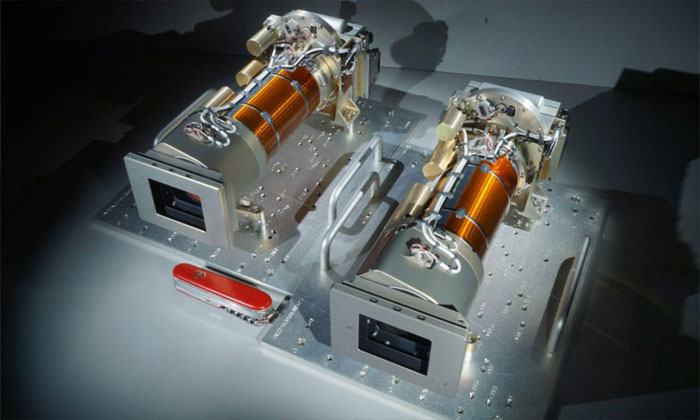
| 18 Feb. 2021 | Mars Rover | Ohara Glass Lands on Mars! Read More |
| Date | Ref | Description |
|---|---|---|
| 29 May. 2026 | Special Order Glass Types | Due to low demand, the following glass types will be moved to Special-Order Glass Types and available for the next 3 years: S-LAL18, S-TIH53W, & S-LAH66. Please contact us directly for recommended alternative glass types and additional information. |
| 29 May. 2026 | Discontinued Glass Types | The following glass types have been discontinued (limited stock may be available upon request): S-LAH79. Please contact us directly. |
| 01 Jan. 2026 | Catalog Data Update | Notice of 2026 Optical Glass PDFs update |
| 18 Apr. 2025 | PBM2R | Radiation-resistant optical glass PBM2R (Radiation Resistant Glass Types) |
| 18 Apr. 2025 | Catalog Data Update | Notice of Catalog Data Update for Temperature Coefficient of Refractive Index Δn/ΔT “Read More” |
| 18 Apr. 2025 | Measurement Equipment | Renewal of Thermal Expansion Measurement Equipment | … all the average coefficient of linear expansion [α], transition point [Tg], and yield point [At] values on our website have been changed with the 2025 catalog update. “Read More“ |
| 07 Feb. 2025 | Fused Silica | SK1300 and SK1310 PDF datasheets updated. |
| 30 Jan. 2025 | S-TIH53WN S-LAH66N S-LAL18N | Introducing S-TIH53WN, S-LAH66N, and S-LAL18N: Meeting High-Precision Lens Demands |
| 06 Jan. 2025 | LICGC AG-01 | Notice of Discontinuation: LICGC AG-01 Plates have been discontinued (limited stock may be available upon request). |
| 28 Oct. 2024 | i-Line Glass | PDF Datasheets to reflect changes to photoelastic constant [β] values. |
| 26 Feb. 2024 | S-FPL53 S-FPL55 | PDF Datasheets updated to reflect changes to coloring λ80λ5 and internal transmission λ0.80/λ0.05 values. |
| 02 Feb. 2024 | S-NBM52 | New Glass Type! S-NBM52 is a new optical glass for polished lenses with higher dispersion while maintaining the same anomalous dispersion as S-NBM51. Read More |
| 08 May. 2023 | Special Order Glass Types | Due to low demand, the following glass types will be moved to Special-Order Glass Types and available for the next 3 years: S-BAH10, S-LAH79, L-TIM28P, S-BAL2, S-TIM22, S-TIH23, S-LAL13, S-LAM54, S-LAH63, & S-LAH63Q. Please contact us directly for recommended alternative glass types and additional information. |
| 08 May. 2023 | Discontinued Glass Types | The following glass types have been discontinued (limited stock may be available upon request): S-FTL10, S-NSL5, S-BAH32, S-TIM39, S-LAM52, S-LAM58, S-YGH51, S-NBH52, S-NBH53, S-TIM1, SNPH53, & L-LAH86. |
| 13 Jan. 2023 | S-LAL61Q | New Glass Type! S-LAL61Q is a new optical glass for polished lenses with improved chemical durability and a mechanical strength equivalent to S-LAL61. Read More |
| 30 Nov. 2022 | S-LAH99W | New Glass Type! S-LAH99W is an optical glass with an improved transmittance version of S-LAH99. Read More |
| 27 Dec. 2021 | S-NBH59 | New Glass Type! S-NBH59 is an optical glass for polishing lens and is effective for secondary chromatic aberration correction. Read More |
| 03 Dec. 2020 | Discontinued Glass Types | The following glass types have been discontinued (limited stock may be available upon request): S-BAH32, S-BAL11, S-BAL41, S-BAM3, S-BSM9, S-BSM22, S-LAL7, S-LAL54, S-LAL56, S-LAM51, S-LAM52, S-LAM58, S-LAM59, S-LAM61, S-NBH52, S-NBH53, S-NPH53, S-NSL5, PBH56, S-TIM1, and S-TIM3. |
| 30 Nov. 2020 | S-FPM5 | New Glass Type! S-FPM5 is an optical glass for polished lenses with a Δn/ΔT close to zero. Read More |
| 06 Mar. 2020 | S-LAL12Q | New Glass Type! S-LAL12Q is an optical glass with improved workability and durability. Read More |
The temperature coefficient of refractive index of each glass type is measured as Δnabs/ΔT according to ISO 6760-1 and from this value the Δnrel/ΔT value normally used in optical design is calculated. The relationship between Δn abs/ΔT and Δn rel/ΔT is given by the following formula.
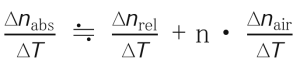
n :Refractive index of glass sample (in air, 25 ° C)
“Internal transmittance” refers to the spectral transmittance of the glass itself, not including reflection losses at the optical glass-air interface; it indicates the transparency of the glass. Most optical glasses absorb a substantial amount of light in the near-ultraviolet region. For some glasses, especially those with a high refractive index, this absorption range also extends into the visible range. This absorption is not only caused by the composition of the glass; it is also affected by impurities in the glass, and varies slightly from melt to melt.
The spectral transmittance (including reflection loss) is measured based on the JOGIS-17 standard at wavelengths from 280 nm to 2400 nm in a pair of glass samples with different distances through which transmitted light passes. Then, the internal transmittance 〔τ<sub>i</sub>(10 mm)〕 at a glass sample thickness of 10 mm is calculated from the measurement data.
The temperature coefficient of the absolute refractive index of glass for wavelengths not listed in the data sheet can be calculated as a function of wavelength and temperature. Ohara uses the following equation.

| n(λ,T0): | Refractive index at reference temperature |
| T0: | Reference temperature (°C) (Ohara defines this as 25°C) |
| T: | Target temperature (°C) |
| λ: | Vacuum wavelength (μm) |
| D0、D1、 D2、E0、 E1、λTK: | Constant (listed in the data sheet) |
To determine the temperature coefficient of the relative refractive index, refer to the equation given in the previous section, “Temperature coefficient of the refractive index”.
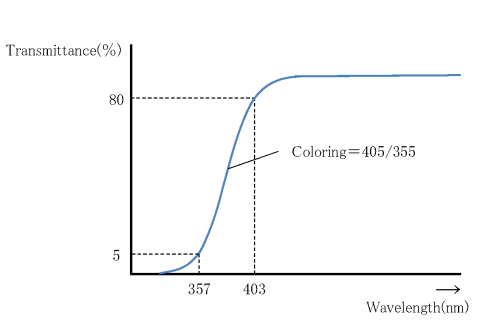
Coloring refers to the degree of coloration of the optical glass and is determined by measuring the spectral transmittance, including reflection losses, for a glass sample with a thickness of 10 mm, according to JOGIS-02. From the spectral transmittance curve (Fig. 3), the wavelengths showing the transmittance of 80% and 5%, respectively, are rounded and displayed in 5 nm units. We use this rounding method: the range 0 nm to 2 nm counts as 0 nm, the range 3 nm to 7 nm counts as 5 nm, the range 8 nm to 10 nm counts as 10 nm . For example, if the wavelength with 80% transmittance is 403 nm and the wavelength with 5% transmittance is 357 nm, the coloring is shown as 405/355.
For glass types with a high refractive index, nd ≥ 1.84, the reflection loss is large, so the wavelength showing transmittance of 70 % is used, instead of 80 %, and the value is shown in paranethesis. For example, (415).
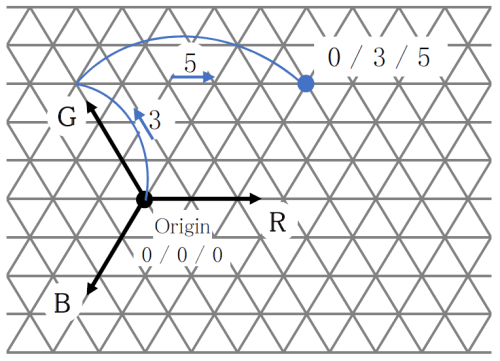
CCI (Color Contribution Index) is an index for predicting how much the color of a photograph taken using a certain lens system changes compared to the original color, due to the spectral characteristics of the lens. It is indicated by a set of 3 numbers for blue (B) / green (G) / red (R). Ohara uses this index to predict how much the color will change as a single glass element. For the measurement method, refer to JIS B 7097 “How to express the color characteristics of a photographic lens by the ISO color characteristic index (ISO / CCI)”. The numbers shown are calculated using the sum of the values of the internal transmittance of the glass sample every 10 nm and the average color film weighted spectral sensitivity, described in JIS. For example, B / G / R of 0/3/5, is shown in Fig. 4 in trilinear coordinates.
When light enters the glass, it slows down inversely proportional to the refractive index compared to in a vacuum or in air. The refractive index of optical glass is usually expressed as the speed ratio of light in the air to themedium (glass sample).
The refractive index is measured by sending a predetermined wavelength of light into the sample and measuring theminimum deviation angle of the emitted light bent by refraction, according to JIS B 7071-1. For the 20 spectral lines shown in the table below, numerical values are shown to five decimal places. The refractive indices (principal refractive indices) for d-line (587.56 nm) and e-line (546.07 nm) are also shown to six decimal places.
| Spectral Line Symbol | t | ||||
| Light Source | Hg | Hg | Hg | Hg | Hg |
| Wavelength (nm) | 2325.42 | 1970.09 | 1529.58 | 1128.64 | 1013.98 |
| Spectral Line Symbol | s | A′ | r | C | C′ |
| Light Source | Cs | K | He | H | Cd |
| Wavelength (nm) | 852.11 | 768.19 | 706.52 | 656.27 | 643.85 |
| Spectral Line Symbol | He-Ne | D | d | e | F |
| Light Source | レーザー | Na | He | Hg | H |
| Wavelength (nm) | 632.8 | 589.29 | 587.56 | 546.07 | 486.13 |
| Spectral Line Symbol | F′ | He-Cd | g | h | i |
| Light Source | Cd | レーザー | Hg | Hg | Hg |
| Wavelength (nm) | 479.99 | 441.57 | 435.835 | 404.656 | 365.015 |
Dispersion refers to the phenomenon arising from a variation in the refractive index depending on the wavelength. Here, nF-nC and nF’-nC’are displayed as the main dispersion. The Abbe number is an index of the magnitude of the variance and is also called the inverse dispersion rate. The larger the variance, the smaller the Abbe number.
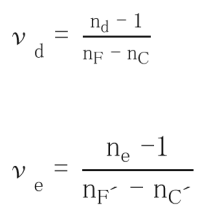
The glass type data sheet indicates the dispersion, calculated from the refractive index to six decimal places . Abbe number is indicated to two decimal places, this is the result of the calculation from nd to six decimal places and the principal dispersion to six decimal places .
Two decimal places: This is the result of calculation from nd to six decimal places (with seven effective digits) and the principal dispersion to six decimal places (with four or more effective digits).
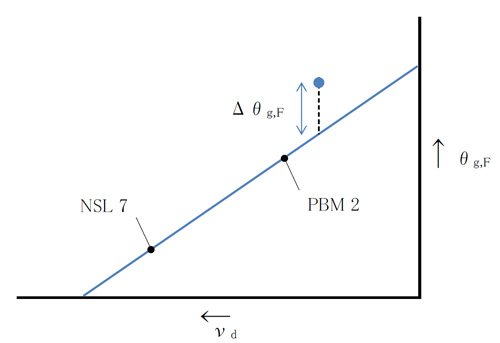
Although NSL 7 and PBM 2 are not currently produced by Ohara, the conventional NSL 7 and PBM 2 values (Table 2) are used as the reference values.
Reference Values
θc,t |
θC,A' |
θg,d |
θg,F |
θi,g |
vd |
|
NSL 7 |
0.8305 |
0.3492 |
1.2391 |
0.5436 |
1.2185 |
60.49 |
PBM 2 |
0.7168 |
0.3198 |
1.2894 |
0.5828 |
1.4214 |
36.26 |
>θg,F-νd図とΔθg,F
The refractive index for wavelengths not listed in the data sheet can be calculated using the dispersion formula. The Sellmeier equation is used as a practical dispersion formula, as detailed below.
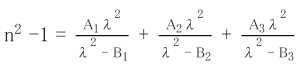
| n : | Refractive index to be calculated |
| λ : | Arbitrary wavelength (μm) |
| A1、A2、A3、B1、B2、B3 : | Constant (listed in the data sheet) |
Using this dispersion formula and the constants for each glass type, the refractive index of any wavelength in the standard measurement wavelength range (365 to 2325 nm) can be calculated with a calculation accuracy of ±5×10<sup>-6</sup>. However, for glass types for which the refractive indices for the entire standard measurement wavelength range are not listed in the data sheet, the applicable wavelength range of the dispersion formula is limited to the refractive index range listed in the data sheet.